Marketing case rounds feel open-ended, so most candidates either freeze or start listing every channel they know. Interviewers aren't looking for a list. They want to see you ask sensible questions, split the problem cleanly, use the numbers in front of you, and give a clear answer.
This post works through one case in the same four steps you'd follow in the room:
- 1Clarify2 minAsk the questions you'd want answered before solving anything.
- 2Structure5 minSplit the problem into 3–5 main areas to look at.
- 3Analyse8 minRead a small data table and say what it tells you.
- 4Recommend3 minGive your answer first, then 2–3 reasons.
The case
A D2C skincare brand has seen customer acquisition cost (CAC) on paid social rise from ₹340 to ₹980 in eighteen months. Revenue is flat. The founder wants to know where to put the next ₹50 lakh of marketing budget. What do you advise?
Notice what the question is. It isn't “why has CAC gone up?” The founder wants to know where the next ₹50 lakh should go. Rising CAC is the symptom that started the conversation. Keep the real question in mind the whole way through.
1Clarify
Before solving anything, ask three to five questions that would change your answer. Good questions are specific, and each one has a reason behind it.
- Is CAC rising across every product, or only one? A single hero product getting expensive is a different problem from the whole brand.
- Has order value or margin changed? ₹980 to win a customer is fine if each customer is worth ₹5,000, and a disaster if they're worth ₹800.
- How quickly does the founder need the money to pay back? This decides how much risk you can take with new channels.
- Is the ₹50 lakh for one quarter or the whole year? Spending it in three months behaves very differently from spending it over twelve.
2Structure
Now break the problem into three to five areas that don't overlap and, together, cover the whole decision. For a “where should the budget go” question, a clean split is:
- Cost to win a customer on each channel (CAC).
- Quality of the customers each channel brings: do they come back and buy again?
- Headroom: how much more money each channel can absorb before it gets expensive.
The third area is the one most candidates miss. A channel can be cheap only because you're spending very little on it, and pouring ₹50 lakh into it would change that.
3Analyse the data
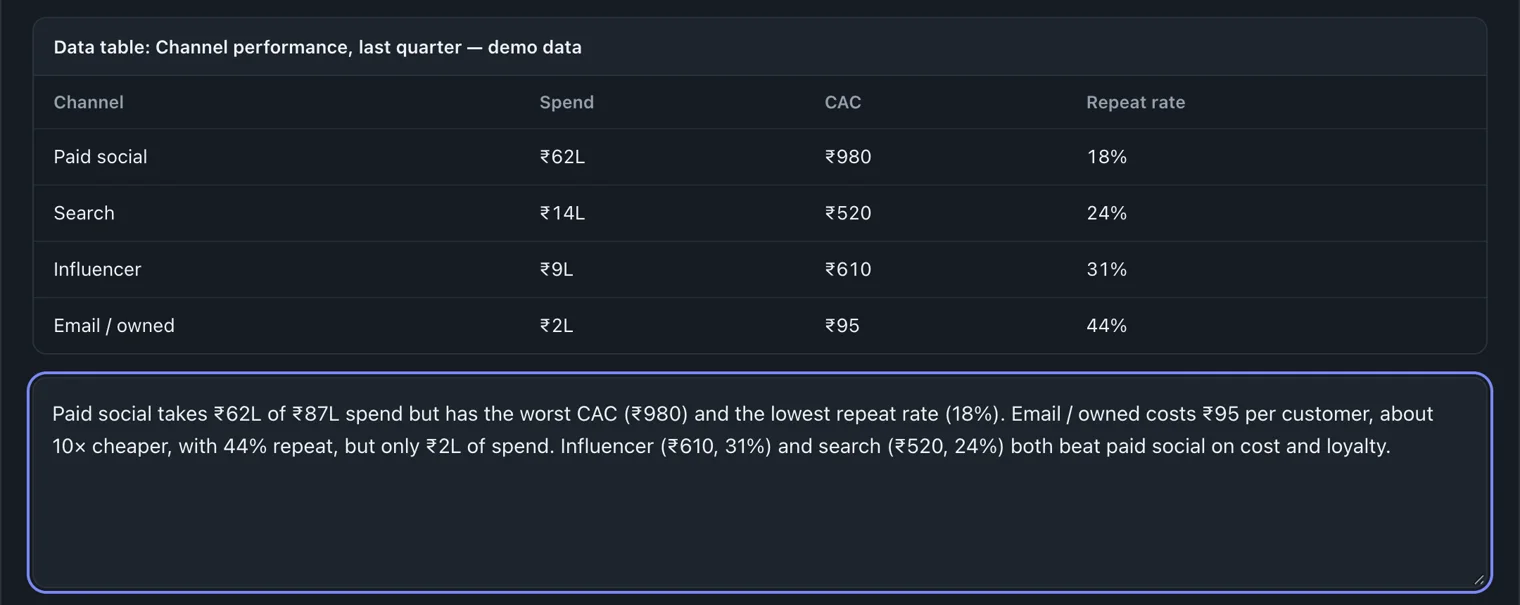
The interviewer hands you this table. The numbers are made up for the case.
| Channel | Spend | CAC | Repeat rate |
|---|---|---|---|
| Paid social | ₹62L | ₹980 | 18% |
| Search | ₹14L | ₹520 | 24% |
| Influencer | ₹9L | ₹610 | 31% |
| Email / owned | ₹2L | ₹95 | 44% |
1. Where the money goes
Total spend is ₹62L + ₹14L + ₹9L + ₹2L = ₹87L. Paid social takes ₹62L of that, about 71%.
So nearly three-quarters of the budget sits in the channel whose cost has nearly tripled.
2. Cost against quality
Paid social costs ₹980 ÷ ₹95 ≈ 10× more per customer than email, and those customers come back far less often (18% against 44%).
3. Cost per customer who comes back
This is the calculation that impresses interviewers. Divide CAC by the repeat rate to get the cost of winning one customer who buys again:
Working: CAC ÷ repeat rate. Paid social ₹980 ÷ 0.18, search ₹520 ÷ 0.24, influencer ₹610 ÷ 0.31, email ₹95 ÷ 0.44.
Two things jump out. Paid social is more than 2.5× as expensive as search or influencer for a customer who comes back. And influencer, which looks pricier than search on CAC alone, is actually slightly cheaper once you account for repeat buying.
Then bring in headroom. Email looks like the obvious winner, but it runs on only ₹2L. You can't move ₹50L into it overnight, because email works on people who are already on your list. Say this out loud. It shows you understand how channels behave in real life, not just on a spreadsheet.
4Recommend
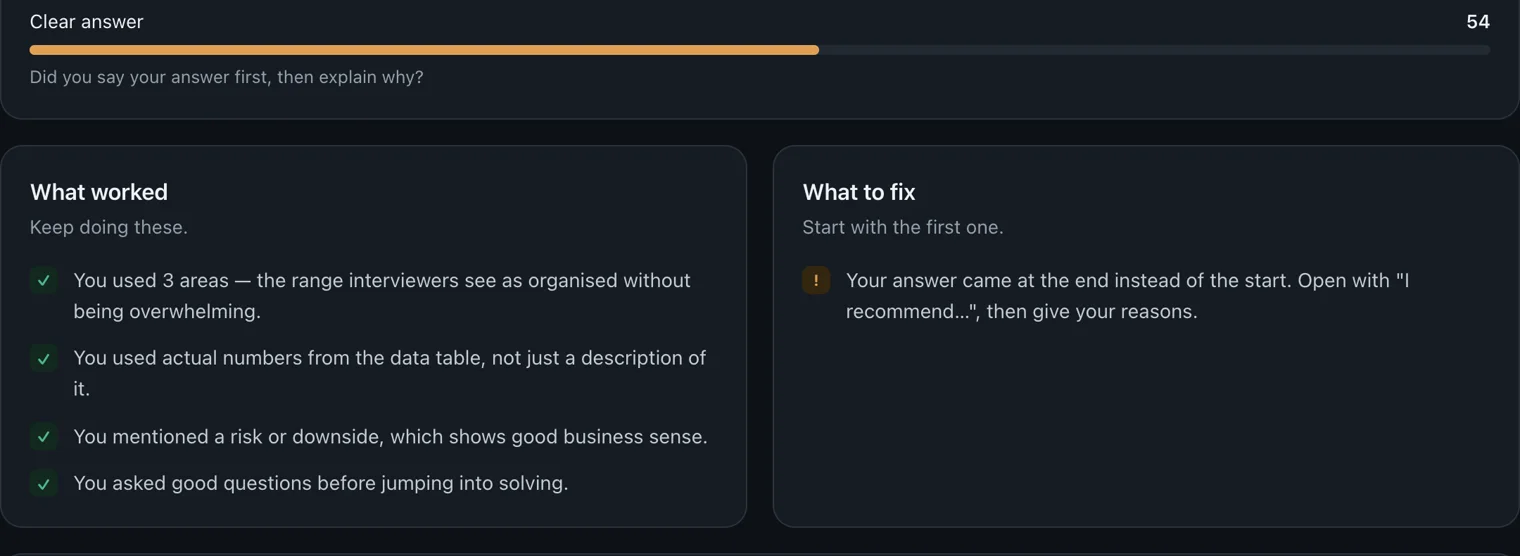
Give your answer in the first sentence, then two or three reasons, then one risk. Candidates who build up to their answer at the end lose marks, even when the thinking is good. The interviewer remembers the first thing you say.
I recommend putting most of the next ₹50 lakh into search and influencer, holding paid social at its current level while we test new creative, and using a small part to grow the email list.
Search and influencer cost less than half as much as paid social for each customer who buys again. Email is the cheapest channel we have, but it can't absorb much money yet, so the right move is to grow the list it runs on.
The risk is that search and influencer get more expensive as we spend more on them. I'd move the money in ₹10 lakh steps and check CAC every month before moving the next step.
Notice what this answer doesn't do: it doesn't cut paid social to zero. It's still where most of today's customers come from, and switching it off in one go is a risk the founder probably can't afford.
Mistakes that cost marks in this case
- Describing the table instead of calculating. Quote numbers and compare them.
- Answering “why did CAC rise?” when the question was where to spend the money.
- Moving all the money to the cheapest channel without asking whether it can take it.
- Saving the recommendation for the end. Lead with it.
- No risk. One sentence on what could go wrong, and how you'd watch for it, shows business sense.
Reading a worked answer makes all of this look obvious. Doing it with a clock running, when you have to write the questions and the maths yourself, is a different skill. That's the part worth practising.